

Reimagining Facilities Management in Residential Estates
From Operations to Experience



Image: Eden Constantino
Introduction
In 2013, while involved with a Facilities Management (FM) company on the Pearl Qatar island, I wrote a document entitled “A Facilities Management Doctrine for the Provision of 21st Century Facilities Management Services.” I introduced that document with the following statement:
“Operations and Maintenance (O&M) challenges as they exist now, and especially as they are likely to emerge, are distributed, networked, diverse in technical nature, and generally different from challenges faced only a few years ago. Acting against such challenges in traditional ways may be too costly, slow, or self-defeating.
O&M activities should not be achieved only through the isolated actions of individuals or by facility managers operating with only their own teams in isolated areas. Joint planning should provide the basis for setting priorities, making operational decisions, and determining resource allocations. System-wide (joint) planning is the foundation of an effective and efficient approach to FM on The Pearl. System-wide planning not only should be inter-precinct and inter-domain in nature (e.g., retail vis-à-vis residential), but interdisciplinary as well (e.g., HVAC vis-à-vis MEP).”
That doctrine was encapsulated in the following framework:
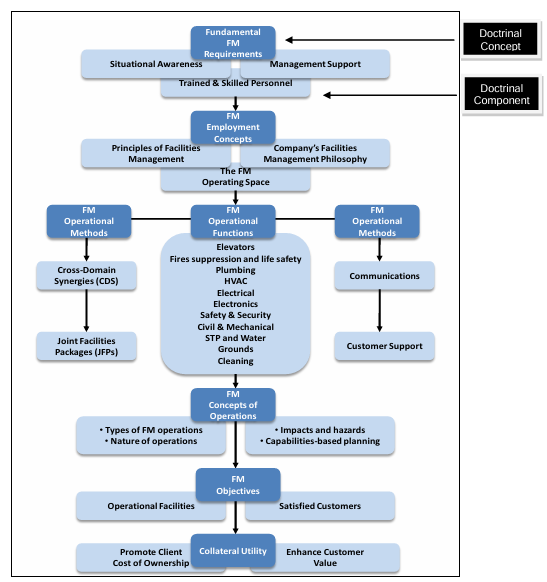
A grand vision at a time when technology was still a limiting factor. So, how far have we come? I think one can safely say that FM has evolved from being a (mainly reactive) maintenance function to a strategic enabler of livelihood, durability, and community value. In residential estates, FM no longer focuses on fixing faults or cutting grass - it now integrates sustainability, technology, information, and community well-being into a coordinated service ecosystem.
In South Africa, this shift has been expedited by energy fragility, physical security threats, and the growing expectation for private estates to deliver what municipalities cannot - stability, safety, and quality of life (SACFM, 2023).
Drawing from the early Facilities Management Doctrine that I developed for The Pearl and the latest IFMA (International Facilities Management Association), ISO, and Smart FM frameworks, this article reinterprets FM as an adaptive system of joint capabilities - blending physical infrastructure, digital intelligence, and human experience.
From Doctrine to Practice: A South African Context
My 2013 FM Doctrine proposed a capabilities-based model for integrated operations- joint planning, cross-domain synergies, and situational awareness through tools like IWMS (Integrated Work Management Systems), GIS (Geospatial Information Systems), and mobile platforms. At the time, this was visionary (and my slip was also showing as far as my military background was concerned…).
Today, those concepts underpin Integrated Facilities Management (IFM) globally (IFMA, 2023). In South Africa’s residential estate context, however, IFM extends beyond technical coordination: it is a socio-technical framework that ensures operational excellence while building community trust and asset value.
The new operational environment - which the estate manager should be on top of - includes:
Hybrid infrastructure - solar PV systems, boreholes, smart meters, and access control platforms.
Energy security as a service - estates increasingly operate as micro-utilities (SAPOA, 2024).
Sustainability regulation - ESG (Environmental, Societal, and Governance) metrics and carbon reporting have entered the FM lexicon (ISO 41001:2018).
Resident engagement - digital portals, apps, and WhatsApp channels have replaced the old helpdesk model (that gave me many headaches!).
In short, SCADA (Supervisory Control and Data Acquisition) systems have become much more open-ended and intuitive, moving away from systems that only engineers could manage and control.
Defining Facilities Management in a Residential Estate
According to ISO 41011 (2017), FM is the “integration of people, place, process and technology to ensure functionality of the built environment.” In estates, this translates into a multidimensional system comprising:
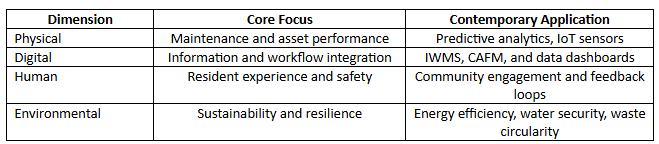
Thus, FM acts as the operational nervous system of the estate - linking technical, environmental, and social subsystems into one coherent whole, or into a system-of-systems.
The Evolution of the Estate/Facilities Manager
For purposes of this document, the terms estate manager and facilities manager are used interchangeably as meaning the same thing. Technically, of course, they are not. Yesterday’s facilities manager was a maintenance coordinator. Today’s closer approximates the traditional estate manager, where (s)he is a systems integrator and community strategist. Modern FM requires competence in:
Data literacy – interpreting energy dashboards, maintenance KPIs, and AI alerts.
Stakeholder management – balancing trustee expectations, resident satisfaction, and contractor performance.
Sustainability governance – aligning estate operations with ISO 14001 and ISO 41001 frameworks (to name but a few - ISO 9001, 31000, and 45001 are also very relevant).
Crisis and risk management – from load-shedding to flash floods and cyber vulnerabilities in smart-estate systems.
In essence, the estate manager of the 2020s must think like a CEO, plan like a strategist, and act like an engineer and first responder (Cotts & Roper, 2021).
Key Drivers Transforming Estate FM
Digitalisation and Smart Infrastructure
Smart metering, IoT devices, and predictive maintenance algorithms allow estates to move from reactive to proactive operations. Cloud-based CAFM (Computer Assisted Facilities Management) platforms enable real-time service tracking, SLA compliance, and mobile workforce management (FMA, 2022).
“The estate is no longer just another residence - it is a living system that thinks, learns, and adapts.”
CAFM systems should enable an estate manager to ensure that at least 80% of all maintenance activities are done proactivly. In practice this is often the other way around, i.e., with reactive maintenance dominating. This is the result of poor planning!
Sustainability and Energy Transition
The push towards carbon-neutral operations and energy resilience is redefining FM. Estates are investing in solar micro-grids, battery storage, and water harvesting systems, which FM teams must operate as hybrid utility providers (Green Building Council SA, 2024).
Security and Resilience
In South Africa, security remains the most critical determinant of perceived estate value. Modern FM integrates surveillance analytics, access-control data, and response coordination into a single command-and-control ecosystem (SACFM, 2023).
Customer Experience (CX)
FM is shifting from being a cost centre to an experience centre. Residents expect immediacy, transparency, and professionalism. Digital feedback, satisfaction dashboards, and “first-time-fix” culture define the new performance standards.
Governance, Risk and Compliance (GRC)
Residential estate FM operates in a semi-municipal space - responsible for public safety, occupational health, and environmental stewardship. Governance frameworks now integrate:
ISO 41001 (Facilities Management Systems) – global standard for FM governance.
King V – for estate boards and trustees acting as “governing bodies.”
POPIA and GDPR compliance – for resident data collected through access and monitoring systems.
These frameworks reinforce transparency, accountability, and value creation - all hallmarks of a mature FM doctrine. And a quick note here on doctrine: doctrine = best practice, and rests on three legs - theory, technology, and experience, So, as an example of the synergistic nature of these three legs: FM theory has been in existence for a long time (proactive vs reactive maintenance, etc), but it is only relatively recently with technological breakthroughs that CAFM systems have truly come to the party. In practice, experience obtained on the day-to-day work refines the theory (this looks good on paper but doesn’t work in pactice), which in turn may lead to new operational (technical) requirements for new systems, or new system functionalities.
Similarly, technology can also be the driver of the three legs, as with the advent of AI which has made preventive maintenance scheduling much easier (it can forecast which of your systems are likely to break down based on histoical performance and maintenance).
The Doctrine Revisited: Capabilities-Based FM for Estates
Reinterpreting my original framework (2013) for today yields the following modern pillars:
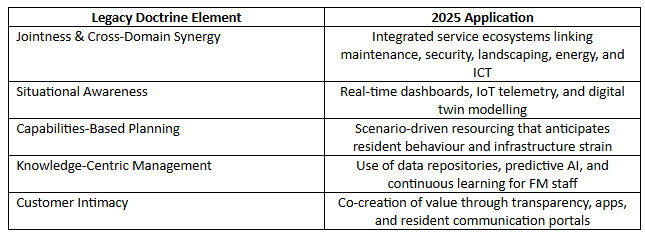
These principles converge on a singular aim - a safe, sustainable, and intelligent living environment.
The South African Imperative
With municipal infrastructure failing, gated communities and residential estates have become the beacons of governance restructuring. Here, facilities/estate managers are no longer just service providers - they are overseers of urban survivability.
FM in this context is nation-building by another name: ensuring that water runs, power flows, people are safe, and communities thrive in the midst of national uncertainty.
Conclusion
Facilities management in residential estates is entering its most transformative decade. It fuses engineering precision, digital intelligence, and social sensitivity into a unified practice that sustains both infrastructure and community well-being.
The 2013 doctrine remains valid: plan jointly, act smartly, and pursue outcomes - not inputs. But its modern incarnation demands new tools, data literacy, and above all, a leadership mindset that treats estates as living systems.
“Tomorrow’s FM leader will not only maintain buildings - they will maintain trust, continuity, and the promise of safe living in an uncertain world.”
References
Cotts, D. and Roper, K.O. (2021) The Facility Management Handbook, 5th ed. New York: AMACOM.
Facilities Management Association of Southern Africa (FMA) (2022) Smart Facilities Management: Digitalising the Built Environment. Johannesburg: FMA.
Green Building Council South Africa (GBCSA) (2024) Net Zero and Sustainable Estates Guidelines. Cape Town: GBCSA.
Greyffenberg, I. (2005) SA Air Force Air Power Doctrine. Pretoria: SAAF.
International Facility Management Association (IFMA) (2023) Trends in Integrated Facility Management. Houston: IFMA.
International Organization for Standardization (ISO) (2018) ISO 41001: Facility Management Systems – Requirements with Guidance for Use. Geneva: ISO.
RICS (2023) Global FM and Asset Management Report. London: RICS.
South African Facilities Management Council (SACFM) (2023) The State of FM in South Africa 2023. Pretoria: SACFM.
South African Property Owners Association (SAPOA) (2024) Residential Estate Infrastructure Report. Johannesburg: SAPOA.
Van Vuuren, I (2013). A Facilities Management Doctrine for the Provision of 21st Century Facilities Management Services. Doha: UFMCo.